How to Play D&D: A Complete Beginner’s Guide
Never played Dungeons & Dragons? Here's how it actually works: what you need, how a turn plays out, how to make a character and how to find a group.

Dungeons & Dragons has a reputation for being complicated. Thick rulebooks, weird dice, people arguing about whether a goblin can see in the dark. And sure, the full rules go deep if you want them to. But the game itself is simple: a group of friends tell a story together, and dice decide what happens when things get risky.
If you can say “I want to try to climb that wall” and roll a die, you can play D&D. Everything else you’ll pick up as you go. This guide covers what you need to get started, how the game actually plays, how to make your first character and where to find people to play with.
Pixel’s first ever session was a one-shot Rook ran on a hot August night in a tiny Thessaloniki flat, with the fan on full blast and dice skidding across a borrowed coffee table. Pixel spent ten minutes trying to befriend a goblin instead of fighting it. It worked. The goblin became the party’s guide for the next eight months, and that was the moment it clicked: you really can just try anything.
What is D&D, exactly?
D&D is a tabletop role-playing game (an RPG). There’s no board you move around and nobody “wins”. One player is the Dungeon Master (the DM), who describes the world, plays every character the heroes meet and runs the monsters. Everyone else plays a single character: a hero they’ve created, like an orc barbarian with a soft spot for cats, or an elf wizard who’s terrified of horses.
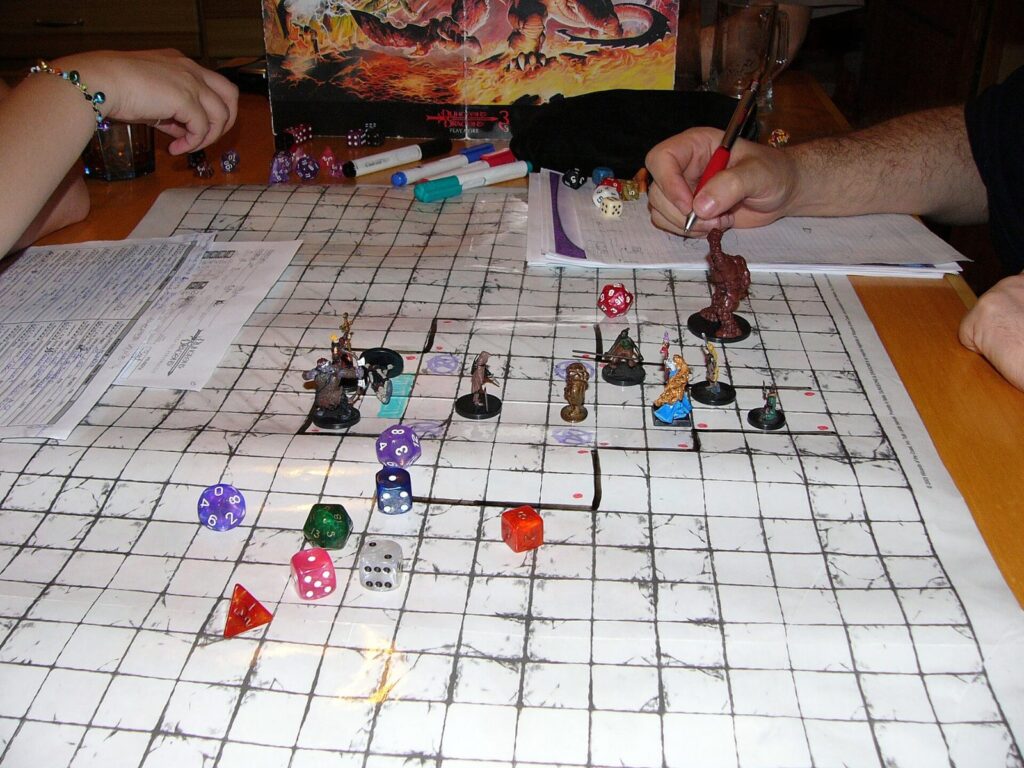
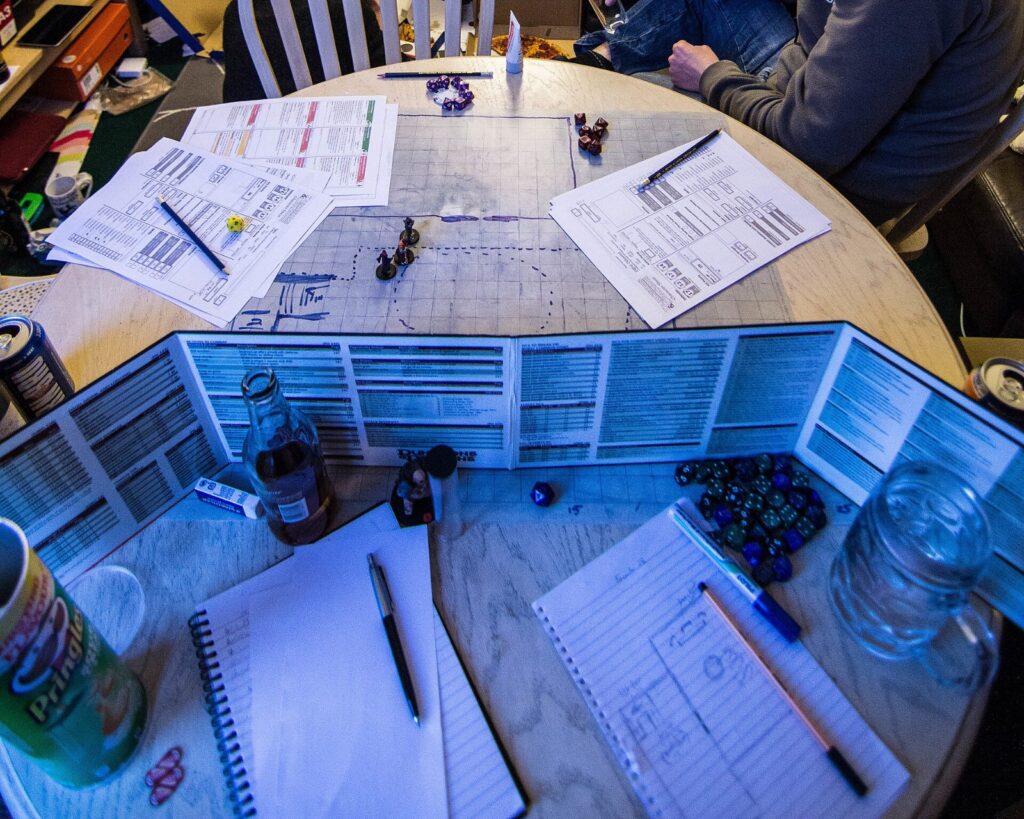
A typical session goes like this. The DM sets the scene (“You walk into a tavern. It’s quiet. Too quiet.”), the players say what their characters do, and the DM tells them what happens next. When the outcome is uncertain, someone rolls dice. A session usually lasts three to four hours, and a group often plays the same story, called a campaign, for months or even years.
What do you need to play D&D?
Less than you think.
- A group. Three to five players plus a DM is the sweet spot. Two players and a DM works fine too.
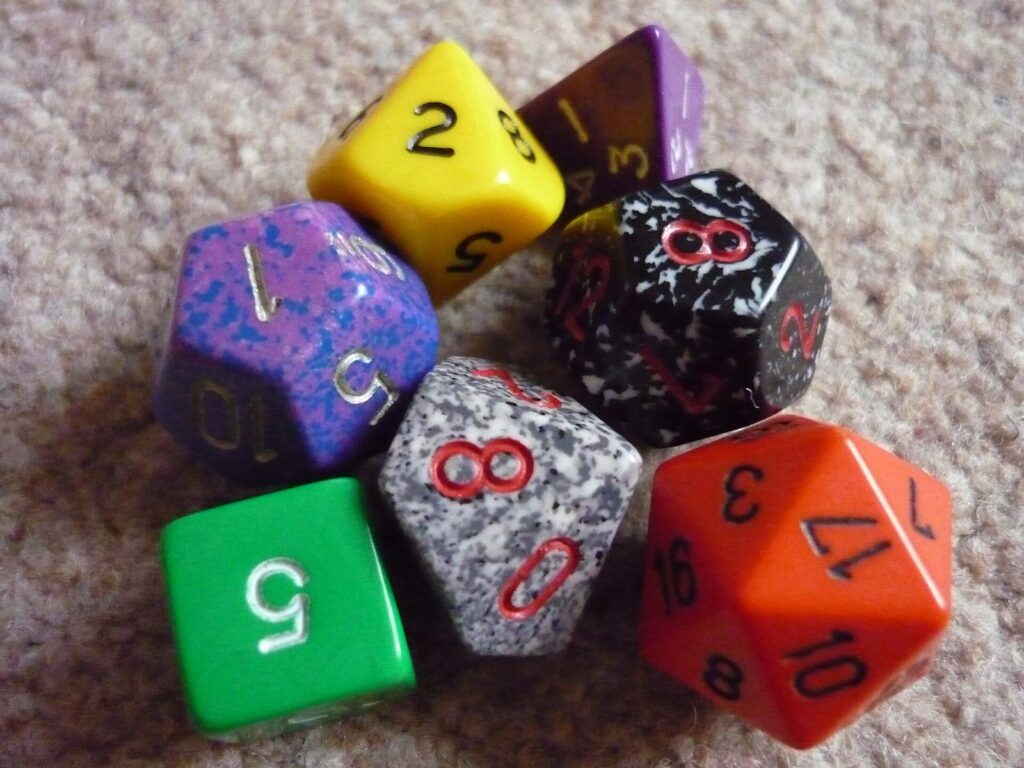
- Dice. A standard set has seven dice: a d4, d6, d8, d10, d12, d20 and a second d10 for percentages (the “d” just means “die”, and the number is how many sides it has). A full set costs a few euros, and free dice apps exist if you’re just trying it out.
- The rules. You don’t need to buy anything to start. Wizards of the Coast released the core rules for free as the System Reference Document (SRD 5.2) in April 2025, and you can read the basic rules for free on D&D Beyond. The Player’s Handbook (the 2024 edition is the current one) is worth buying once you know you love it.
- A character sheet. One page that holds everything about your hero. Print one, or let D&D Beyond build it for you.
- Pencils and something to snack on. Non-negotiable.

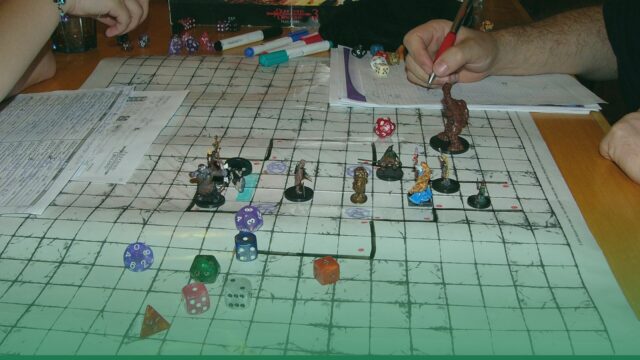
Miniatures, battle maps and fancy dice towers are all optional. Plenty of groups play entirely “theatre of the mind”, with no map at all.
Where to get it: D&D Starter Set, D&D Beyond
How does D&D work? The one rule that matters
Almost everything in D&D comes down to one move: roll a d20, add a number, and try to beat a target.
Say your character wants to jump across a chasm. The DM decides it’s tricky and sets a target number, called the Difficulty Class (DC), of 15. You roll the twenty-sided die, add your character’s Athletics bonus (let’s say +4), and if the total is 15 or more, you make it. Roll a 9? You’re hanging off the edge by your fingertips, and the DM gets to decide what happens next.
That same pattern covers attacks (you roll to beat the monster’s Armor Class), saving throws (you roll to resist a poison or dodge a fireball) and skill checks (persuading a guard, picking a lock, remembering an old legend).
Two more things you’ll hear constantly:
- Advantage and disadvantage. If the situation helps you (you’re attacking a sleeping enemy), you roll two d20s and keep the higher. If it hurts you (you’re attacking in pitch darkness), you roll two and keep the lower. Simple, and it feels great.
- Natural 20 and natural 1. Rolling a 20 on the die itself is a critical hit in combat: you roll extra damage dice. Rolling a 1 on an attack is an automatic miss. Your table will cheer and groan accordingly.
The six abilities
Every character has six ability scores. They’re the backbone of the character sheet.
| Ability | What it covers | Who loves it |
|---|---|---|
| Strength | Lifting, climbing, hitting things hard | Barbarians, Fighters |
| Dexterity | Agility, reflexes, sneaking, archery | Rogues, Rangers, Monks |
| Constitution | Health and stamina | Everyone (more hit points) |
| Intelligence | Memory, reasoning, book learning | Wizards |
| Wisdom | Perception, intuition, willpower | Clerics, Druids |
| Charisma | Charm, confidence, force of personality | Bards, Sorcerers, Warlocks, Paladins |
Each score gives you a modifier, the small number you actually add to your rolls. A score of 10 gives +0, 14 gives +2, 18 gives +4. Your character sheet does the maths for you.
How to make your first D&D character
Character creation is where a lot of new players get stuck, mostly because there are so many cool options. Here’s the short version.
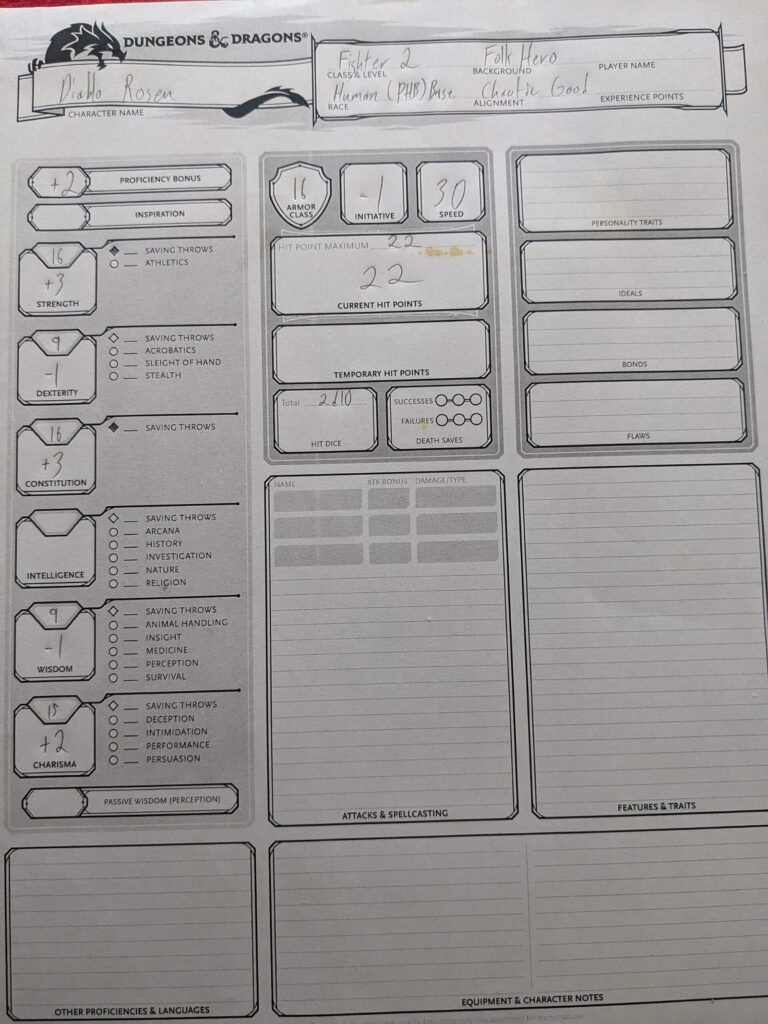
- Pick a class. This is what your character does: Fighter, Wizard, Rogue, Cleric and so on. There are twelve in the core rules. If you’re not sure, a Fighter or a Rogue is easy to play, and a Cleric is always welcome. We’ll go through every class in a separate guide soon.
- Pick a background. Who were you before adventuring? A soldier, a sailor, a criminal, a scholar. In the 2024 rules your background also boosts some of your ability scores and gives you a starting skill set.
- Pick a species. Human, elf, dwarf, halfling, orc, dragonborn, tiefling and a few more. Each one comes with a couple of special traits, like darkvision or resistance to fire.
- Set your ability scores. The easiest method is the standard array: assign 15, 14, 13, 12, 10 and 8 to the six abilities, putting the biggest numbers in what your class needs most.
- Choose equipment and spells. Your class gives you a starting kit. Casters pick a handful of spells.
- Give them a personality. A name, a reason to adventure, one fear and one thing they want. This is the part that makes the game fun, so don’t skip it.
Honestly, the fastest way to start is to grab one of the pre-generated characters that come with official adventures and starter boxes. You can always make your own once you know how the game feels.
How combat works in D&D
Combat is the most rules-heavy part of the game, but it follows a clear loop.
- Roll initiative. Everyone rolls a d20 plus their Dexterity modifier. That sets the turn order.
- Take your turn. On your turn you can move (usually 30 feet) and take one action: attack, cast a spell, dash, hide, help a friend. Some abilities also give you a bonus action.
- React when it’s not your turn. Each round you get one reaction, most often used for an attack when an enemy tries to run past you.
- Repeat until one side wins, runs or surrenders.
Damage comes off your hit points. Hit zero and you fall unconscious and start making death saving throws: on each of your turns, roll a d20, and 10 or higher is a success. Three successes and you stabilise. Three failures and your character dies. It’s the most tense moment in the game, and every table has a story about it.

What does the Dungeon Master do?
The DM is part storyteller, part referee, part improv actor. They prepare (or buy) an adventure, describe what the players see, voice every innkeeper and villain, and make rulings when the rules don’t cover something. The golden rule for a DM: the rules serve the fun, not the other way around. If a ruling keeps the game moving and everyone’s having a good time, it’s the right call.
Thinking of running a game yourself? It’s less scary than it sounds. We’re working on a step-by-step guide to running your first session.
Before your first game: talk about it
Good groups have a quick chat before the campaign starts, usually called a session zero. You agree on the tone (silly or serious?), how often you’ll play, and anything people don’t want in the game. Many tables use simple tools for this, like “lines and veils”: lines are topics that never appear, veils are things that happen off-screen. It takes twenty minutes and saves a lot of awkward moments later.
How to find a D&D group
- Ask your friends. You’d be surprised how many people have always wanted to try.
- Local game shops and board game cafés. Many run beginner nights and ongoing games. In Athens, No Label X in Exarcheia has been running D&D and other tabletop games for years. Wherever you are in Greece, ask at your local hobby shop: they usually know which groups are looking for players.
- Online. Virtual tabletops like Roll20 and Foundry VTT let you play over the internet with people anywhere. Discord servers and Reddit’s r/lfg are full of groups looking for players, including complete beginners.
- Start your own. Grab a short official adventure, find three friends, and learn together. Some of the best groups start exactly like that.
Common beginner questions
Do I need to buy the books to play D&D?
No. The core rules are free through the SRD and D&D Beyond’s basic rules. The books add more options, more monsters and a lot of inspiration, so they’re worth it once you’re hooked.
How long does a D&D session take?
Most sessions run three to four hours. One-shots (a complete adventure in a single session) are a great way to try the game before committing to a long campaign.
What’s the difference between 5e and the 2024 rules?
The 2024 Player’s Handbook is an updated version of fifth edition, sometimes called 5.5e. It cleans up a lot of rules, rebalances classes and changes how backgrounds work, but it’s compatible with older 5e adventures. If you’re starting now, start with the 2024 rules.
Can you play D&D with two people?
Yes: one DM and one player works, and it can be a really personal story. Most published adventures assume three to five players, so the DM will need to tone down the fights.
Is D&D hard to learn?
Not really. The core of the game is “describe what you do, roll a d20 if it’s risky”. You’ll learn the details naturally over your first two or three sessions, and nobody at a good table expects you to know everything.
Roll for initiative
The best advice we can give is simple: stop reading and play. Your first session will be a bit messy, someone will forget what their spell does, and the DM will make up at least one rule on the spot. That’s how everyone learns. A few sessions in, you’ll be the one explaining advantage to a new player.
When you’re ready for more, check out The Best Music for Your D&D Sessions to set the mood, and keep an eye out for our list of tabletop RPGs that aren’t D&D if you want to see what else is out there.